For as big a boardhead (the term I’ll be using to describe board game fans from now on) as I am, it’s a small wonder that I’ve never taken the drive to nearby Philadelphia to experience the annual PAX unplugged expo. Boy, am I kicking myself for that. I’ve never played as many games in a short amount of time. Some games I’ve wanted to play for some time, some were just released, some were about to be released next year, and some were in the playtesting phase.
Here’s everything.
Steam Up: A Feast of Dim Sum (2023, Hot Banana Games)

What could be more fun than a game themed around eating dim sum? We made sure to seek out this game as soon as I heard about it. Dim Sum is one of our favorite cuisines, and this game leans into the theme. The pieces are high quality and delightful.
In the game, players take turns taking tokens which will enable them to take steamer baskets full of dim sum treats (Shu Mai, Dumplings, Sticky Rice, Pork Bao, and Chicken feet). They can also take a whole steamer basket once they’ve acquired enough of the appropriate tokens and score points according to their player mat. Each player mat is styled according to the 12 Chinese Zodiac signs and has unique powers and scoring abilities. The art is charming and creative!
We could only play a brief demo, so my understanding of the strategy is a bit limited. But the game’s most interesting mechanic is a rotating lazy susan in the center. On some actions, you’re allowed to rotate it, which can make the difference in getting the steamer basket you want or denying your opponent.
Steam up is currently being funded through Kickstarter, but is expected to release next year.
Azul (2017, Next Move Games)
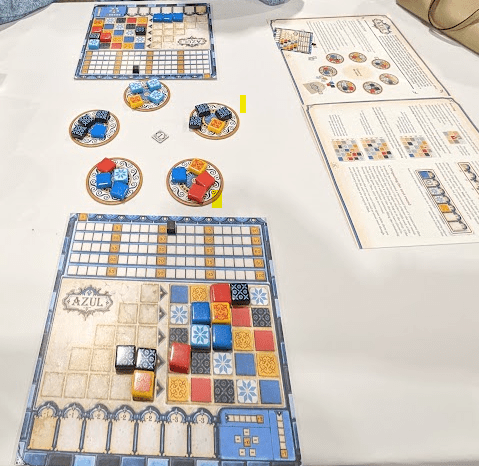
This game has been on my radar for some time, and it’s easy to understand why. For starters, the game is just beautiful. It’s a tile-laying game inspired by Portuguese mosaics, most of which are blue (Hence the name, which means “Blue” in Portuguese). As a fan of the other famous Iberian-inspired tile laying game, Alhambra, I knew this one would be for me.
Tiles are randomly placed on “factories” at the center of the table, which players can choose from. However, if a player takes from a factory, they must take all the same color tiles and push the rest towards the center. Other players can get these but are bound to the same rules. The tactical nature of the game comes down to making sure you’ve taken exactly the right amount of tiles you need while being wary of what you think your opponent might do! You’re punished for taking too many.
Every time you complete a row on the pyramid, you move a tile into the mosaic. The game is over as soon as a player makes a complete row. Points are awarded by a system that incentivizes having as many tiles adjacent to each other as possible.
Azul is an excellent game, which I will be adding to my library shortly. As this game has been out a long time, many, many variations and expansions have been released, including one where players are chocolatiers!
Bear Hugs (unreleased)
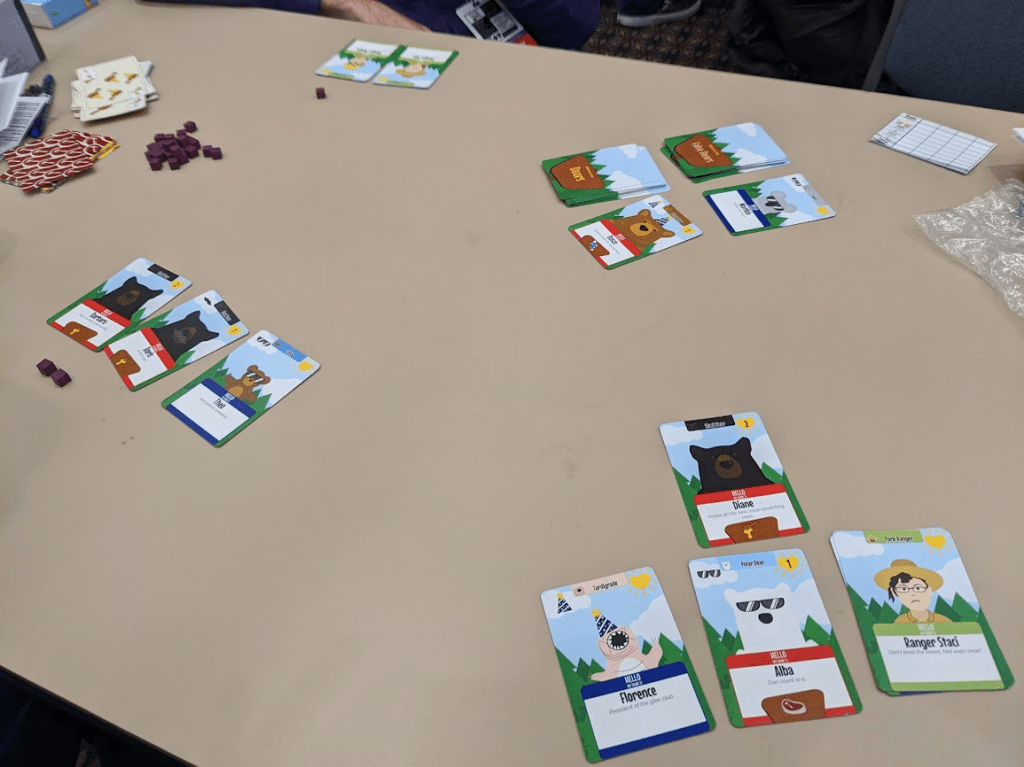
The Unpub area is full of many developers looking for feedback on games they’re working on, and we were eager to check it out. I was delighted to find that many of these devs are excited to share their ideas and hear from us. As an aspiring game designer, it made me quite happy.
So the first game we played here was called Bear Hugs. It’s a trick-taking card game, made very simple by easy-to-understand mechanics. The theme is that you’re hikers in a park hoping to hug as many bears as possible (inadvisable in reality). Each turn has an actual bear (Grizzly, Black, and Polar) available for points. There are also false bears (Tardigrades, Teddy, and Koala) available to whoever gets second place in the trick. Mixed in with both true and false are park rangers, which count against you when you take them.
The underlying strategy involves being aware of your opponents’ bait while keeping track of the bears they’ve already acquired. You can’t see the cards in your opponent’s hand, but each bait card (meat, honey, fish) has a different back, so you can make a fair guess at the power of your opponents. It’s an exciting way of making trick-based games a bit more accessible.
Keep an eye out for Bear Hugs when it is released!
Pirates Dragon Treasure (2022)

Here’s a game we saw while passing through the exhibition hall that caught my interest. I chatted with a developer, and he said the theme was to get his friends who wanted an RPG pirate experience into a light board game. The theme and concept immediately piqued my interest, so we made sure to get this game out of the library and check it out.
In the game, you play as a ship of pirates who are each trying to take out the game’s main villain, a randomly drawn Dragon. You take turns upgrading your crew and ship while sabotaging your opponent. When you are confident that your crew can take on the Dragon, you have the option to do so. Whoever beats the Dragon wins the game.
Unfortunately, the game didn’t grab us as much as we thought it would. The turns didn’t feel exciting, as we were mostly just waiting for the right cards to upgrade our ship. We had sabotage cards but didn’t feel the need to play them, as this would have slowed down the game. When one of us felt confident to take on the dragon, it was fairly anticlimactic.
Maybe our experience would have been better if we’d played with more than two people, but overall, I give this game a pass. It’s a shame, because pirates and draons are both things I love.
Captain Sonar (2016, Matagot)
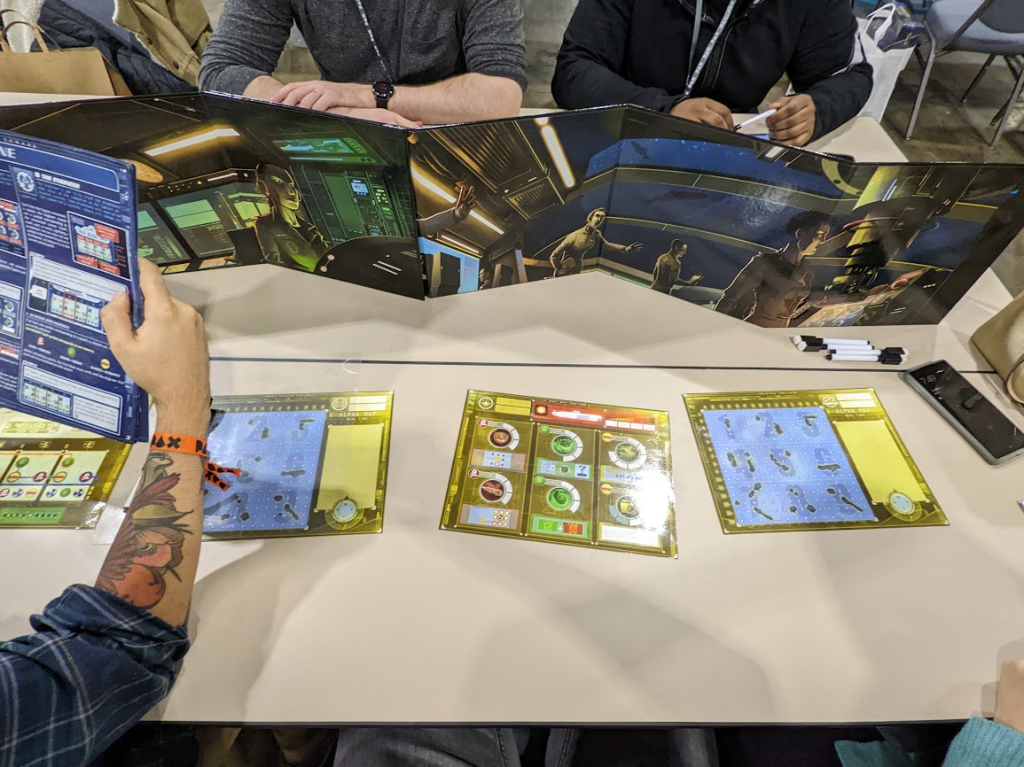
This is the best game I played at PAX unplugged.
Captain Sonar can best be described as a “Team Battleship, but real-time.” In the game, you can play up to 8 people, two 4-person teams representing a submarine crew. Each player has a task: the captain decides which direction the submarine will travel, the first mate is in charge of the weapons, the engineer makes sure power is redirected so that the ship doesn’t break down, and the radio operator tracks enemy movements. The winner is the one who destroys the enemy sub.
This game is tense. Every time the captain moves the ship in one of the cardinal directions, they must call that out to the enemy. But if the enemy is good, they can pay attention to what you’re saying and gather more information. So you have to be sneaky and learn to cooperate with your teammates quickly. Surfacing has the benefit of repairing any damage done to your engines, but it also gives away your location. A maneuver we figured out works really well is to save up your “silence” ability right after you surface. When you play this ability, the enemy team can seldom figure out where you went.
Since you can never know where the enemy sub is, landing a hit with your torpedoes or mines is a beautiful feeling. Cheers and jeers accompanied our table as the winning team (mine) defeated the enemy. Highly recommended.
Klask (2014, Klask ApS)
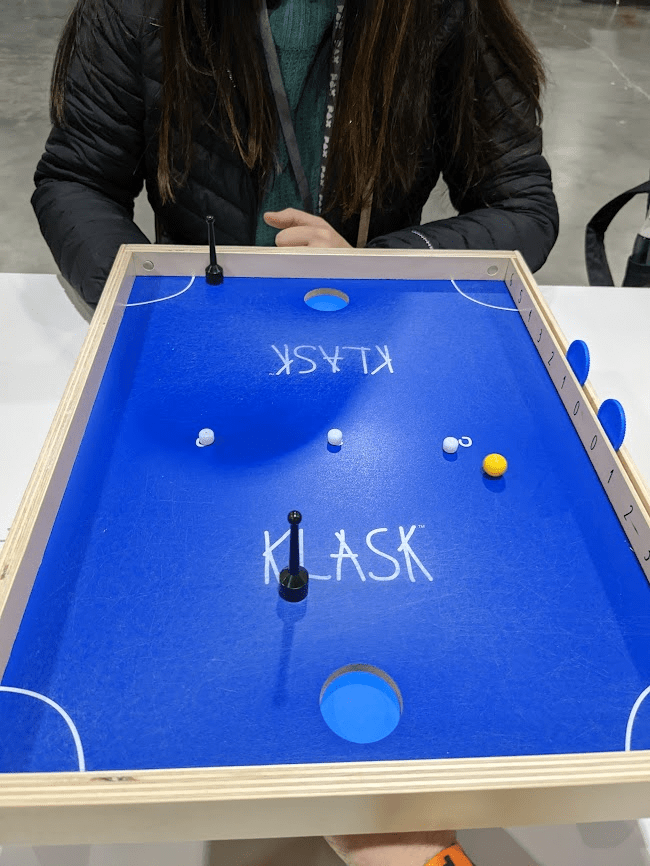
A bunch of these boards were set up in the big exhibition hall, and it looked easy, so we decided to give it a shot. It’s a solid air-hockey-like dexterity game that’s based on magnets! You can’t touch the paddle but can guide it with a magnet underneath. As you can see, the goal is to get the ball into the enemy hole.
Easy to pick up and fun to play. Just looks kind of expensive. You’d probably keep this one in a basement or bar beside the shuffleboard.
Diatoms (2023)

On our last day at PAX, we returned to the UnPub area to see if anything was interesting. We came across this gem of a mosaic-building game that two others were setting up to play.
Diatoms is a game still in development where you play as hobby biologists in the Victorian era working to make microscopic mosaics out of microorganisms. The game developer gave us a rundown of the history, and it turns out this is real!
On your turn, you arrange tiles according to a pattern that is being built on the game board. Wherever a corner was made during placement, you can examine it with a little microscope tool (This part is optional, but it is pretty fun) to determine which microorganism pieces you get to take and place on your own mosaic board. But it isn’t enough to just take the pieces; placement is everything. You’re awarded points for symmetry, both in color in shape. You’re also awarded points for a diversity of pieces and having more of a specific piece.
The game is delightful, and it was great to be able to both play a game in development and also provide feedback to the developer. As an aspiring board game designer myself, it’s lovely to be able to communicate with someone as they’re in the process of making their own game. This is one I’m going to keep my eyes on!
Tokyo Highway (2016, itten)

Here’s another game I’ve been itching to play for some time. A dexterity and physics-based balancing game, Tokyo Highway has been gaining popularity.
In Tokyo Highway, each player trades off building sections of the highway on the table. If you build it above or below an unoccupied area, you can place one of your own cars. The first player who uses all ten of their cars wins.
This game was so frustrating that we had to stop playing. I can see it being fun to play in a group setting, but every time you knock down something, you have to reassemble it and surrender some of your pieces to your opponent. Compare this with Jenga, where knocking down the tower is just the game’s conclusion.
I didn’t dislike the game, but in a setting where we were looking to play as many as possible, we were eager to move on.
Catapult Feud (2021, Vesuvius Media)
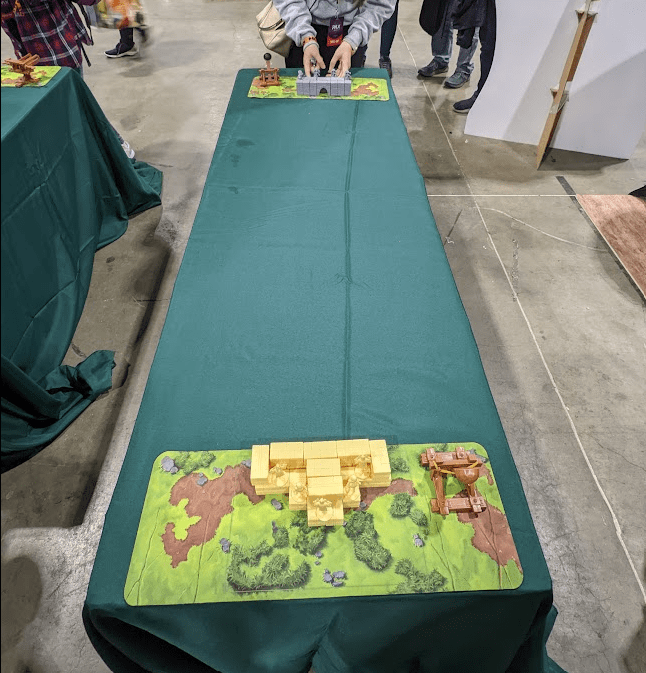
Before we left on Sunday, we spent a bunch of time passing through the exhibition hall, trying to see which games we could play very quickly. This one caught my interest, mainly because it looked effortless to pick up.
You might say that Catapult Feud works more as a toy than a game, and I guess I’d agree. It’s just building a castle and lobbing projectiles at each other. Whoever knocks down all of the enemy’s soldiers first is the winner. As a physics teacher, this seems like a great way to get students talking about projectile motion, but as a gamer, it seems a bit light. There could definitely be more mechanics to make this game deeper, but that would defeat its simple charm.
Clear the Decks (unreleased)

Avast! A card-based cooperative naval combat game! As a big fan of the movie Master and Commander: The Far side of the world, I long for a game that recreates the tension of being on board a gunship in the age of high sail.
Clear the decks is a game about targeting, prioritizing, and tactics. Each player controls one gun crew targeting the same enemy ship. It is cooperate or perish, as at the end of each player’s turn, the enemy fires back at the same player. If one player dies, the whole game is over.
The strategy in this game is to balance using your guns effectively, as every time you fire a cannon, it flips over into a “reload” phase. This renders it practical for the next turn. So, you could fire all your guns at once, but you’d be completely exposed to enemy fire by the next turn. Sometimes, this is not a bad strategy, like if you’re nearing the end of the game and think you can swiftly take the enemy out.
Each gun in the game is different and capable of firing different types of ammo. Different ammo damages different targets on the enemy ship, so you must think strategically before you fire your shot. Do you waste your round shot? Or do you try to conserve it for later use?
Radlands (2021, Roxley)
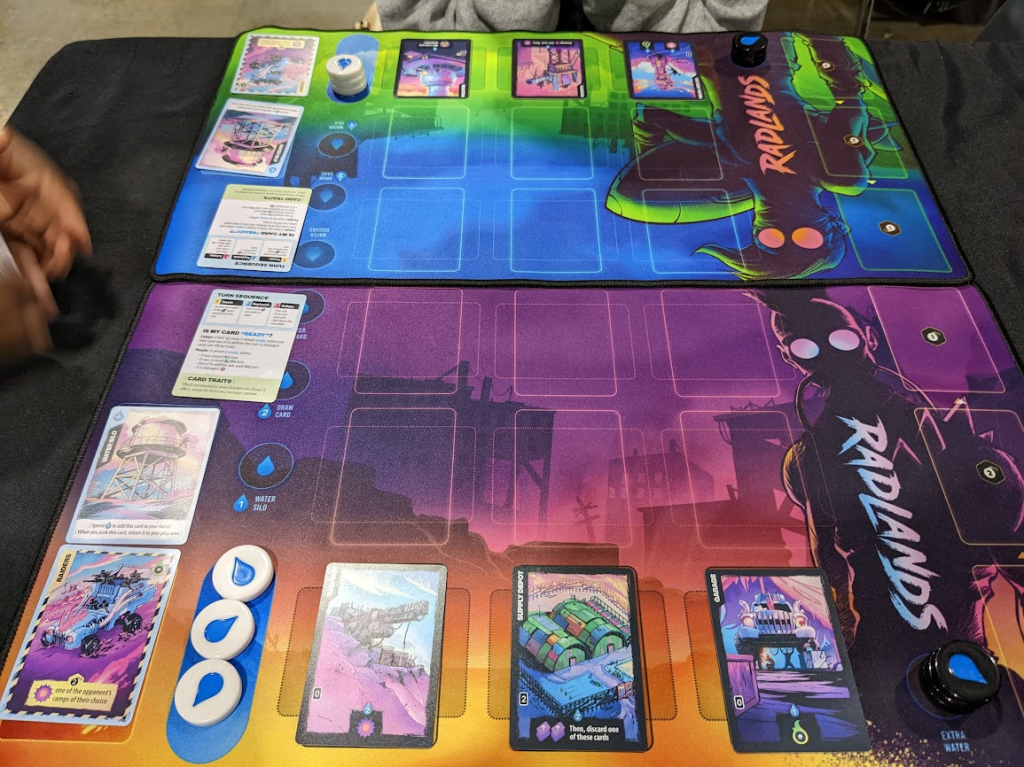
Witness me!
The brightly colored Radlands is made by the same company that makes Dice Throne, so I was expecting something as exciting along the same lines.
Although we only got to play a demo version of the game, we were able to experience a decent amount of the gameplay. In Radlands, you play a gang of survivors in a Mad Max-style desert post-apocalypse setting. Your gang has a base, the features of which are decided randomly and placed into three different lanes on the board. This lane system is the main game mechanic of Radlands, as you send your characters to attack and defend along a specific lane. Every time you deploy a new character, you must pay its cost in water, which is the game’s primary resource.
Radlands is pretty good, but it’s one of those games that seems to rely on deck knowledge to get the most out of play. Still, I’d gladly return to the wastelands and give this one another play.
 chemicalbernswrites